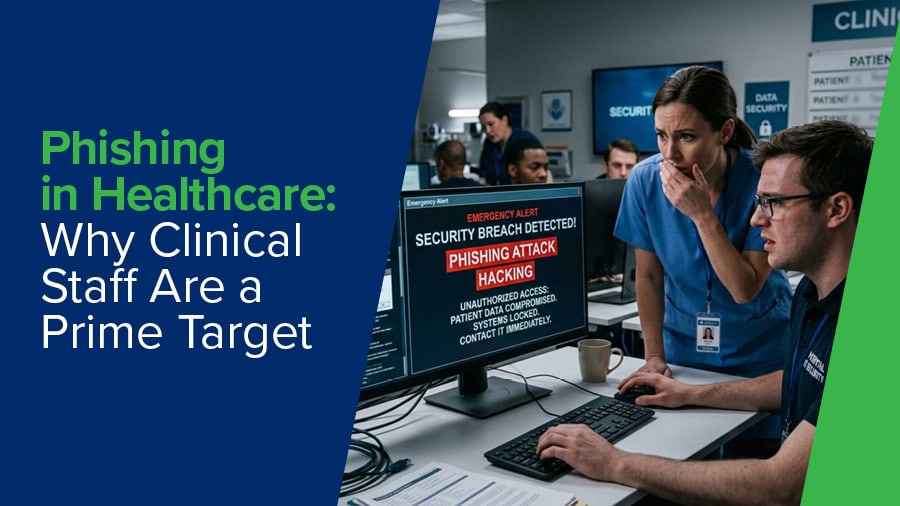
Healthcare organizations invest heavily in firewalls, encryption, and endpoint protection. But attackers often bypass all of it with a single well-crafted email. Phishing attacks remain one of the leading initial attack vectors in healthcare data breaches, and clinical staff are increasingly in the crosshairs.
Why Clinicians Are High-Value Targets
Nurses, physicians, and medical assistants operate under constant time pressure. They click quickly, switch between systems, and routinely receive urgent communications from unfamiliar senders, including labs, insurers, referral partners, and medical device vendors.
Attackers understand these workflow realities. They create phishing emails that resemble EHR notifications, prescription alerts, scheduling updates, or patient-related communications. The goal is not to fool a cybersecurity expert. It is to fool someone balancing patient care and technology at the same time.
Clinical staff also commonly have elevated system access. A compromised clinician credential does not simply expose a single patient record. It can potentially create access to larger volumes of sensitive patient information and critical systems.
What Phishing Looks Like in a Clinical Setting
Modern healthcare phishing attacks are increasingly targeted and convincing. Common examples include:
• Credential harvesting through fake EHR login pages following a “system update” notification
• Business email compromise impersonating a department leader requesting financial information, wire transfers, or W-2 documentation
• Malware delivery through attachments disguised as lab results, referral documents, or prior authorization forms
• Smishing attacks, or phishing through SMS messages, targeting staff on personal devices used for work communication
The continued growth of telehealth and remote work has also expanded the healthcare attack surface. Clinicians accessing systems from home networks and personal devices can create additional security challenges compared to users operating within a managed healthcare environment.
The Organizational Gap
Most phishing awareness programs are designed around traditional office environments rather than clinical workflows.
Generic messaging such as “think before you click” often fails to reflect the pace and realities of emergency departments, outpatient clinics, and patient care environments. Training that does not align with clinical workflows frequently becomes ineffective, and over time staff engagement can decline.
Organizations struggling with phishing prevention are not necessarily dealing with employees who do not care about cybersecurity. Often, the issue is that the training does not reflect how people actually perform their work.
If your security awareness program was designed for a standard office setting, it may not translate effectively into healthcare environments.
Building a Clinician-Aware Defense
Effective phishing prevention in healthcare requires more than an annual compliance training exercise. It should include:
• Simulations designed around clinical workflows that reflect the messages clinicians commonly receive
• Just-in-time reinforcement that provides immediate feedback after simulated phishing events
• A reporting culture that makes suspicious email reporting easy and non-punitive
• Technical safeguards including email filtering, DMARC, DKIM, and multi-factor authentication (MFA) that minimize workflow disruption
Phishing is not solely a technology problem. It requires a strategy that combines people, process, and technology.
Bottom Line
Clinical staff are not the weakest link in healthcare cybersecurity. They are among the most frequently targeted.
Organizations that treat phishing prevention as a compliance requirement alone will continue to struggle. Organizations that build training, culture, and technical safeguards around how clinicians actually work are positioned to reduce risk and stop attacks before they become healthcare data breaches.