
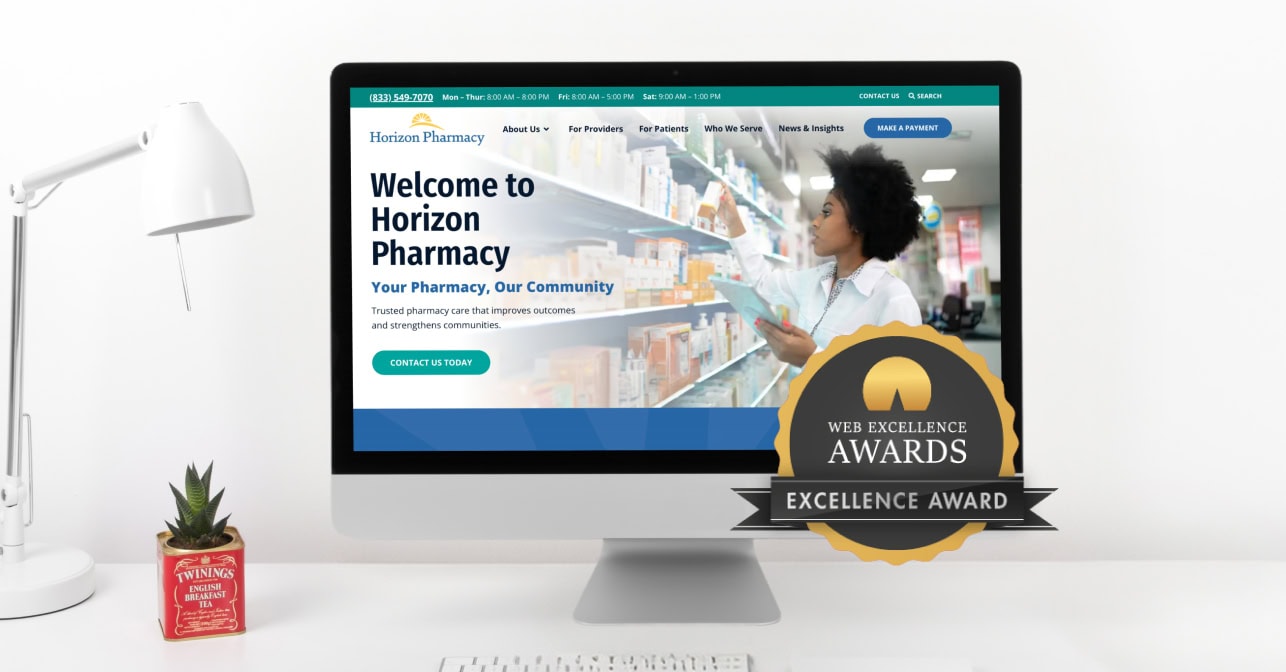
About Horizon Pharmacy
The Horizon Pharmacy website redesign transforms a fragmented, outdated digital experience into a modern, user-centered platform designed specifically for healthcare providers managing complex medication workflows, while supporting a broad range of interconnected user groups.
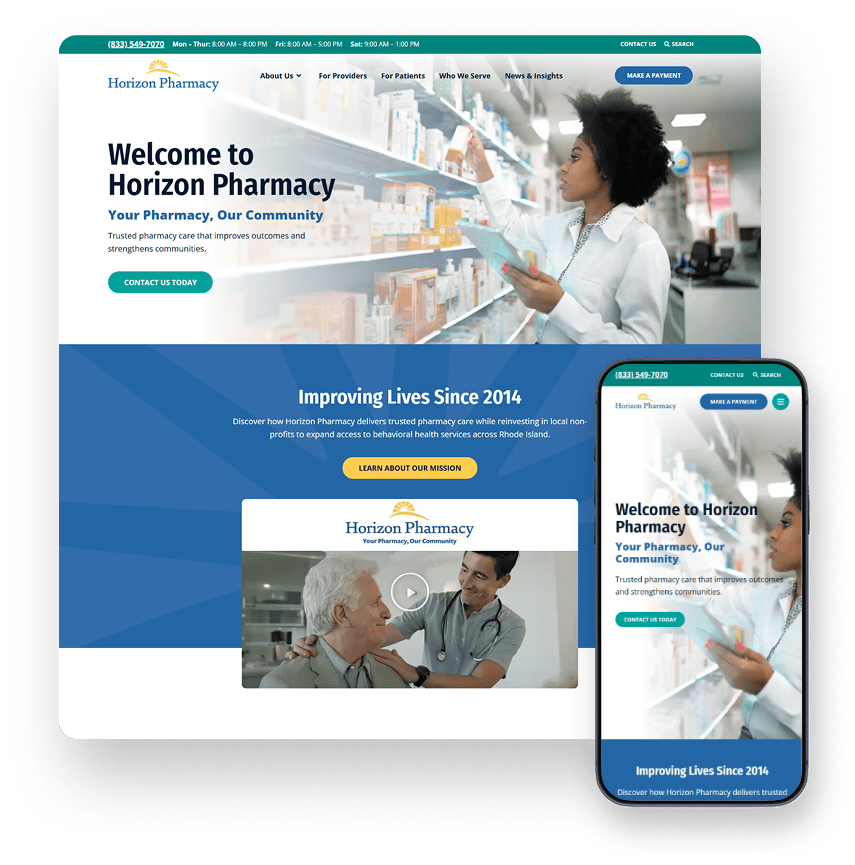
Founded in 2014 and based in Rhode Island, Horizon Pharmacy serves long-term care and behavioral health facilities, as well as the broader network of patients, caregivers, and stakeholders they support. The organization operates under a unique social enterprise model, reinvesting its profits into nonprofit partners that support behavioral health and underserved communities.
The new website was designed to solve three critical challenges: driving new B2B partnerships by clearly communicating Horizon’s value to facilities, supporting an expanding patient and captive audience with accessible service information, and establishing a scalable platform for ongoing content, visibility, and long-term growth.
The Challenge
The legacy website was built on outdated, unsupported technology and lacked a cohesive structure. Navigation was fragmented, content was disorganized, and messaging was generic, making it difficult for users to quickly understand Horizon’s services or take action. The experience did not reflect the organization’s scale, its differentiated service model, or the complexity of its audiences.
The redesigned experience introduces structured, audience-specific pathways that guide users efficiently to relevant information.
Horizon serves multiple user groups that include healthcare providers, nurses, patients, caregivers, employees, and government stakeholders, each with distinct needs. The previous experience did not effectively prioritize or guide any of these audiences.
Audience-Driven UX
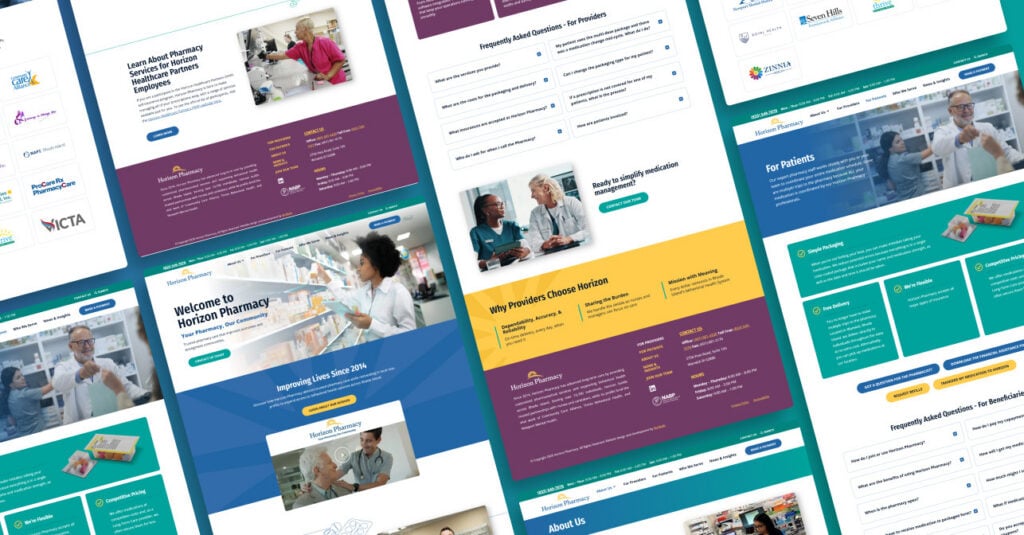
The experience intentionally supports two primary audiences: healthcare providers and facility staff, as well as patients. Dedicated pathways were created for each group, with provider-focused content supporting partnership evaluation and decision-making, and patient-focused experiences enabling access to services such as prescription transfers and direct communication with pharmacists. This ensures the site effectively supports both partnership development and patient engagement.
Information Architecture & Content
The site was restructured to create clear, intuitive pathways for each audience segment. Content was rewritten to align with Horizon’s mission of simplifying medicine management through trusted relationships, while clearly communicating its concierge-level service model, high adherence rates, and operational reliability.
Particular emphasis was placed on supporting facility decision-makers by providing comprehensive, easy-to-navigate service information, clear answers to common questions, and access to real-world examples of successful partnerships. Core service capabilities—such as Horizon’s advanced medication packaging solutions, including multi-dose blister packaging designed to support adherence in long-term care, behavioral health, and residential settings—are clearly communicated throughout the experience. This allows prospective partners to quickly evaluate Horizon’s offerings and understand how they can support their residents and staff.
To reinforce credibility and trust, a robust testimonial strategy was implemented across the site. The homepage features a curated set of client testimonials alongside associated organization logos, each linking directly to partner websites. This approach highlights real-world relationships and outcomes while strengthening Horizon’s position as a trusted provider within its network. These partner organizations are further showcased on the “Who We Serve” page, creating a consistent and interconnected representation of Horizon’s ecosystem.
The information architecture also accounts for Horizon’s dual audience model, with clearly defined pathways for both healthcare providers (B2B) and patients (B2C). Within the patient experience, an additional audience segment—employees of Horizon’s parent organization enrolled in its captive healthcare model—was incorporated into the homepage and supporting content. This ensures that all user groups can quickly identify relevant resources and engage with the services most applicable to their needs.
Functional integrations were also incorporated to support key user actions and streamline common workflows. Patients can securely transfer prescriptions, submit questions to pharmacists, and access support through embedded third-party systems. A custom payment form was also developed to enable clients and patients to pay bills online directly through the website. Additionally, both provider and patient pathways include dedicated FAQ sections to address common inquiries and reduce friction in the decision-making process.
To support ongoing engagement and thought leadership, a News & Insights section was developed as part of the site’s content strategy. The section is actively maintained, with regular updates highlighting company news, employee features, community involvement, and leadership visibility through interviews and podcasts. Content is organized by category to improve discoverability and allow users to quickly access topics relevant to their interests.
To communicate Horizon’s growth and long-term impact, a graphical timeline was developed on the About page, highlighting key milestones from the organization’s founding through its continued expansion. The timeline presents major developments in services, technology investments, and geographic growth, providing visitors with a clear, engaging narrative of Horizon’s evolution and future direction.
Visual Design System
The design balances clinical professionalism with a human, community-centered tone. A custom illustration style—combining commissioned line drawings with complementary vector artwork—creates a distinctive and cohesive visual identity.
Nurse-focused imagery and illustrations were intentionally incorporated into key service pages, reinforcing the role of clinical staff as the primary audience and aligning the visual experience with real-world usage and decision-making.
Subtle visual cues were also used to guide users across audience-specific pathways. Distinct color treatments differentiate key sections of the experience—for example, patient-focused content is presented using a consistent green palette, while provider-focused service content utilizes plum and yellow accents. These visual distinctions help users quickly orient themselves within the site and navigate to the information most relevant to their role.
Representation was also a key consideration in image selection. Photography was intentionally curated to reflect the diversity of both the patient populations served and the healthcare professionals supported, reinforcing Horizon’s commitment to inclusive, community-based care.
Technical Execution
The site was developed on a modern WordPress framework using the Elementor page builder with a fully custom theme and design system, enabling long-term scalability, flexible content management, and ease of ongoing maintenance. Accessibility, performance optimization, and SEO best practices were implemented throughout.
Impact
The redesigned platform now accurately reflects Horizon’s scale and operational impact:
- 10,700+ clients served since inception
- 140,000+ prescriptions filled annually, with continued growth
- 1,500 individuals supported annually through its profit redistribution model
The new site improves how partner facilities engage with Horizon by making it easier to explore services, evaluate partnership value, and connect with the team. It also enhances the experience for patients and other stakeholders by providing clear access to services, support resources, and key actions such as prescription transfers, pharmacist inquiries, and online payments. Testimonials, FAQs, and dedicated audience pathways were intentionally integrated to streamline decision-making and reinforce trust across all user groups.
Equally important, the platform enables internal staff to manage and update content independently, transforming the website from a static, difficult-to-maintain asset into a sustainable business tool.
Conclusion
This project demonstrates how aligning UX strategy, content, and design with real-world healthcare needs can create a digital experience that builds trust, clearly communicates value, and supports informed decision-making for providers, patients, and the broader community.