There’s a moment every manufacturer dreads and most never prepare for.
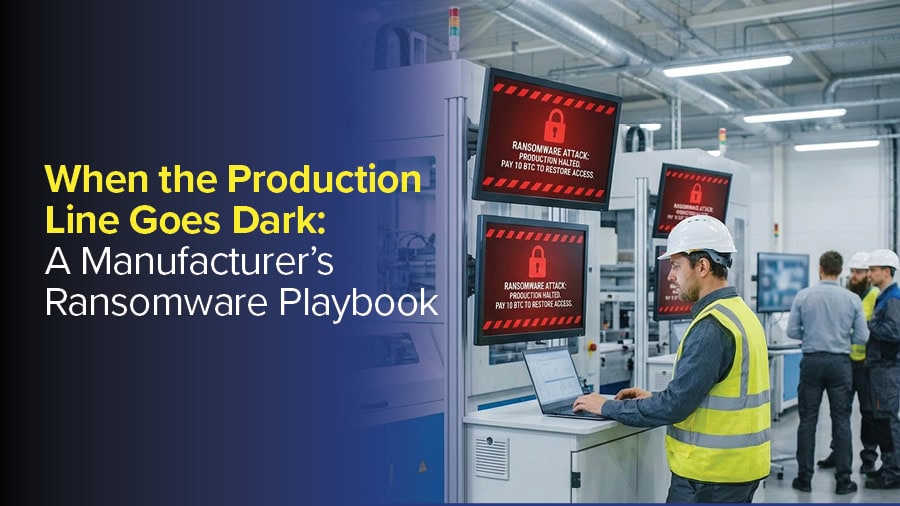
The shift supervisor calls. The HMI screens are frozen. The PLC isn’t responding. Nothing on the production floor is moving. The IT manager starts getting the picture: this isn’t a glitch. Someone got in. And now your production line is dark.
Ransomware attacks against manufacturers have shifted from an edge case to an expected cybersecurity threat. Manufacturing has remained one of the most targeted industries for ransomware attacks in recent years, and the attacks continue to grow in sophistication and impact.
When ransomware reaches an operational technology (OT) environment, the consequences extend well beyond IT. Downtime leads to missed shipments, broken supply chain commitments, idle employees, lost revenue, and in some cases, damaged equipment.
The question isn’t whether your manufacturing organization could be targeted. The question is what happens during the first four hours after it is.
Why Manufacturers Are a Prime Target for Ransomware
Ransomware groups operate like businesses. They target organizations where downtime is expensive, negotiating leverage is high, and cybersecurity gaps are common. Manufacturers check all three boxes.
Operational technology (OT) environments, including PLCs, SCADA systems, HMIs, and industrial control systems (ICS), were built for reliability and uptime rather than cybersecurity.
Many systems:
- Run legacy operating systems
- Cannot be patched without interrupting production
- Use protocols that lack modern authentication
- Connect to ERP systems, cloud platforms, vendors, and supplier portals
These connections create pathways attackers can follow from a phishing email on an office workstation to equipment running the production line.
Meanwhile, the traditional separation between IT and OT teams often leaves security responsibilities fragmented. Those organizational gaps frequently become opportunities for attackers.
What Actually Happens During a Manufacturing Ransomware Attack
Most manufacturers picture ransomware as a single event.
In reality, the attack is usually the final stage of an intrusion that began days or even weeks earlier.
Threat actors often spend significant time:
- Mapping the network
- Identifying backup systems
- Locating sensitive data
- Escalating privileges
- Positioning themselves for maximum operational disruption
By the time production stops, much of the attack has already taken place.
Once ransomware becomes visible, multiple response efforts begin simultaneously.
Operational Response
How can production continue manually or partially?
Which production lines can be isolated?
Which OT assets can be disconnected to prevent additional spread?
Legal and Regulatory Response
Organizations may have immediate notification obligations depending on customer contracts, regulatory requirements, or industry standards.
Defense contractors may face CMMC obligations.
Organizations handling European data may have GDPR notification requirements.
Recovery
Are backups isolated and fully tested?
Were backup systems compromised?
Who has authority to authorize ransom negotiations if necessary?
Communications
Customers, suppliers, insurers, and employees all require timely communication.
Who is responsible?
What information should be shared?
When should it be communicated?
Manufacturers rarely struggle because they lack technology.
They struggle because these decisions were never made before the incident occurred.
The Playbook: Five Things to Decide Before a Ransomware Incident
An effective ransomware response begins long before an attack occurs.
1. Define Critical Systems and Acceptable Downtime
Not every system has equal business value.
Identify which production lines, business applications, and operational processes must recover first, and establish realistic recovery objectives.
This requires collaboration across IT, operations, finance, and executive leadership.
2. Segment IT and OT Networks
If business systems and production systems communicate without appropriate controls, ransomware can spread rapidly.
Network segmentation reduces the blast radius of an attack and improves containment.
Implement it.
Document it.
Test it regularly.
3. Maintain Isolated and Tested Backups
Backups stored on the same network as production systems are not sufficient.
Backup strategies should include:
- Isolation
- Regular restoration testing
- Recovery time validation
- Integration into incident response planning
Success isn’t measured by having backups.
It’s measured by knowing they will restore operations within acceptable business timelines.
4. Build Your Incident Response Team Before You Need It
Every manufacturing organization should clearly define:
- Incident declaration authority
- Cyber insurance contacts
- IT recovery leadership
- OT recovery leadership
- Customer communications
- Supplier communications
- Executive decision-makers
These responsibilities should be documented, rehearsed, and reviewed regularly.
5. Understand Your Cyber Insurance Requirements
Cyber insurance policies increasingly require organizations to maintain specific cybersecurity controls.
Examples include:
- Multi-factor authentication (MFA)
- Secure remote access
- Documented patch management
- Incident response planning
- Backup testing
Review policy requirements before an incident occurs, not during the claims process.
Building Manufacturing Cyber Resilience
Vertikal6 works with manufacturers throughout New England to strengthen cybersecurity programs before incidents occur.
Through the elevate™ ADVANTAGE vCISO practice, organizations receive strategic cybersecurity leadership, structured risk assessments, governance guidance, and compliance support designed specifically for manufacturers that need executive-level security expertise without building a full in-house security team.
Bottom Line
No cybersecurity program can guarantee that ransomware will never occur.
The goal is resilience.
Manufacturers that understand their risks, define their response procedures, test their plans, and prepare their teams are far better positioned to contain incidents, recover operations, and minimize business disruption when ransomware strikes.