
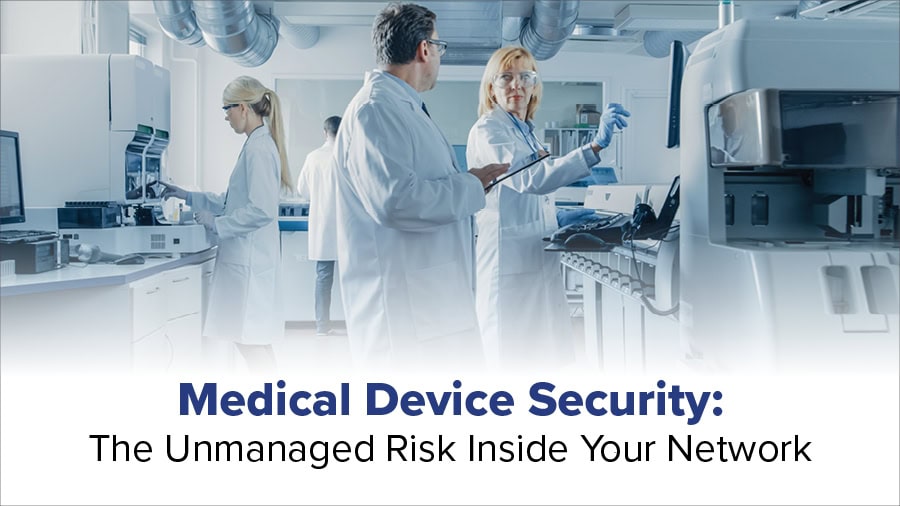
There’s a category of endpoint on most hospital and healthcare networks that does not have a security agent installed, does not receive regular patches, and often cannot be rebooted without affecting patient care. It is also connected to the same network as your EHR, billing systems, and administrative infrastructure.
That endpoint is your medical device fleet.
Medical device security remains one of the most under-addressed risk areas in healthcare cybersecurity and one of the fastest-growing attack surfaces facing healthcare organizations today.
The Scale of the Problem
The average hospital environment includes thousands of connected medical devices, including infusion pumps, imaging systems, patient monitors, ventilators, laboratory equipment, and a growing number of IoT-enabled diagnostic tools.
Many of these devices operate on embedded operating systems, including older Windows environments or proprietary firmware that were not designed with modern cybersecurity requirements in mind.
Many cannot be patched without manufacturer involvement. Some operate on unsupported operating systems. Almost none support the endpoint detection and response (EDR) tools commonly used to protect traditional IT systems.
Why Attackers Target Medical Devices
Medical devices create an attractive pathway into healthcare environments for two primary reasons: they are connected and frequently under-monitored.
Once a threat actor gains access to a connected device, it can become a pivot point for lateral movement across the network toward EHR systems, administrative applications, backup infrastructure, or sensitive patient information.
Medical device compromise can also create direct patient safety concerns. Attacks that manipulate infusion pump settings, disrupt patient monitoring equipment, or interfere with imaging systems introduce risks that extend beyond data exposure alone.
The Visibility Gap
One of the most common findings during healthcare cybersecurity assessments is that organizations do not maintain a complete inventory of connected medical devices.
Devices may be added without formal IT onboarding processes, communicate through legacy protocols, or operate on guest and shadow network segments that are not routinely monitored.
You cannot secure systems you cannot see.
Within healthcare environments, it is common for devices to remain connected to networks for years without formal tracking, including:
- Patch history
- Monitoring status
- Ownership documentation
- Access control requirements
- Risk classification
This is not simply a technology issue. It is often a governance issue.
Building a Medical Device Security Program
Effective medical device cybersecurity begins with visibility and expands from there:
• Asset discovery: Identify all connected medical devices, including devices operating on shadow segments.
• Risk stratification: Prioritize devices based on clinical importance and network exposure.
• Network segmentation: Separate medical device traffic from core IT systems using VLANs or dedicated network segments.
• Patch coordination: Work with manufacturers to establish patch timelines and compensating controls for systems that cannot be updated.
• Continuous monitoring: Implement behavioral monitoring to identify unusual activity, even where security agents cannot be installed.
Regulatory Context
Regulatory expectations around healthcare cybersecurity continue to evolve.
The FDA has issued updated cybersecurity guidance for medical device manufacturers, while the HIPAA Security Rule requires covered entities to protect systems that store, process, or transmit electronic protected health information (ePHI), including medical devices that interact with patient information.
As regulatory scrutiny increases, organizations without documented medical device security programs may face increased compliance and liability risks.
Bottom Line
Medical devices are endpoints. They connect to networks, communicate with critical systems, and create cybersecurity risks that many security programs still do not fully address.
Establishing governance, visibility, and security controls around your medical device environment remains one of the highest-value steps healthcare organizations can take to reduce risk and strengthen their cybersecurity posture.