
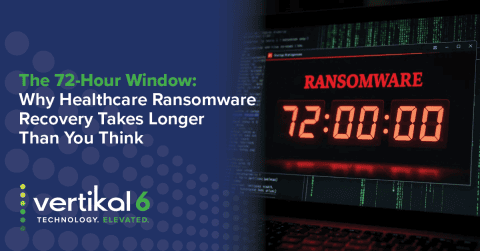
When ransomware hits a healthcare organization, leadership often asks: “How long until we’re back to normal?” The answer is rarely simple. Unlike other industries where recovery might take hours or days, healthcare faces unique challenges that extend recovery timelines to 72 hours or longer—even with backups in place.
Why Healthcare Can’t Just “Restore from Backup”
The phrase “we have backups” offers false comfort in healthcare environments. Your EHR doesn’t operate in isolation—it connects to pharmacy systems, laboratory information systems, radiology PACS, medical devices, and billing platforms. Restoring the EHR without its dependencies creates data integrity issues worse than the ransomware itself.
Patient safety requirements slow the process in ways that don’t exist in other industries. Each restored system requires clinical workflow testing with actual staff. Nurses must verify that medication administration records sync correctly. Laboratory technicians must confirm that results flow accurately to patient charts. These aren’t IT tasks—they’re clinical safety requirements that take hours per system.
HIPAA requires confirmation that patient data wasn’t compromised. Before declaring systems operational, you must verify access controls and audit logging. Breach notification calculations depend on forensic findings about what data attackers accessed—and you can’t complete those assessments while rushing systems back online.
“I’ve seen healthcare organizations with seemingly well-engineered backups still take three days to restore operations,” says Vin DiPippo, Chief Technology Officer at Vertikal6. The goal isn’t just confirming backups by technical standards—it’s about reliably restoring the interconnected clinical systems that ensure patient safety. You must ensure backups take these dependencies into account, and then you can’t skip the verification steps just to move faster.”
The Reality of 72-Hour Recovery
The first 8 hours focus on containment—isolating affected systems and understanding attack scope. Hours 8-24 involve forensic analysis to identify how attackers maintained persistence and verifying backup integrity. Sometimes clean backups are weeks old, creating data gaps to reconcile.
Hours 24-48 bring staged system restoration. Critical clinical systems come first, but each must be validated independently before reconnection. Testing integrations between restored systems consumes significant time—the pharmacy system might work perfectly alone, but does it communicate correctly with the restored EHR?
Hours 48-72 focus on bringing remaining systems online and validating end-to-end workflows. Clinical staff must walk through actual patient care workflows to confirm everything works as expected. Paper records created during downtime must be scanned or manually entered into restored systems.
What Extends Recovery Beyond 72 Hours
Compromised backups force significantly longer timelines. Attackers increasingly target backup systems before deploying ransomware. When recent backups are compromised, you must identify clean backups from potentially weeks earlier, creating massive data reconstruction challenges.
Legacy systems complicate restoration. Older medical devices may not support modern security configurations. Specialized clinical systems from niche vendors may lack 24/7 emergency response capabilities. Custom integrations require rebuilding rather than simple restoration.
Staffing constraints become critical after 24 hours. IT teams working around the clock eventually need rest. Exhausted technicians make mistakes that extend timelines. Vendor support may not be immediately available 24/7.
Preparing for Faster Recovery
“The organizations that recover fastest are the ones who’ve practiced their recovery procedures and know exactly which systems to prioritize for patient safety,” DiPippo notes. “That process definitively identifies gaps in the backup technology, coverage, coordination, and manual processes that all work together to ensure a successful recovery.”
Map all clinical system connections and data flows in detail. Practice restoring systems in priority order during tabletop exercises. Maintain offline backups immune to network-based attacks. Test backup integrity monthly, not just during disasters.
Train staff on paper-based workflows before a crisis occurs. Stock adequate downtime forms and supplies. Define clear decision authority for clinical versus technical recovery choices.
Conclusion
The 72-hour healthcare ransomware recovery window isn’t a worst-case scenario—it’s a realistic timeline for organizations with good preparation. The complexity of clinical systems, patient safety requirements, and regulatory obligations simply cannot be rushed. Healthcare leaders who understand these constraints can better prepare their organizations and set realistic expectations with boards and clinical staff.
The question isn’t whether you’ll face a 72-hour recovery—it’s whether you’ll be ready when it happens.