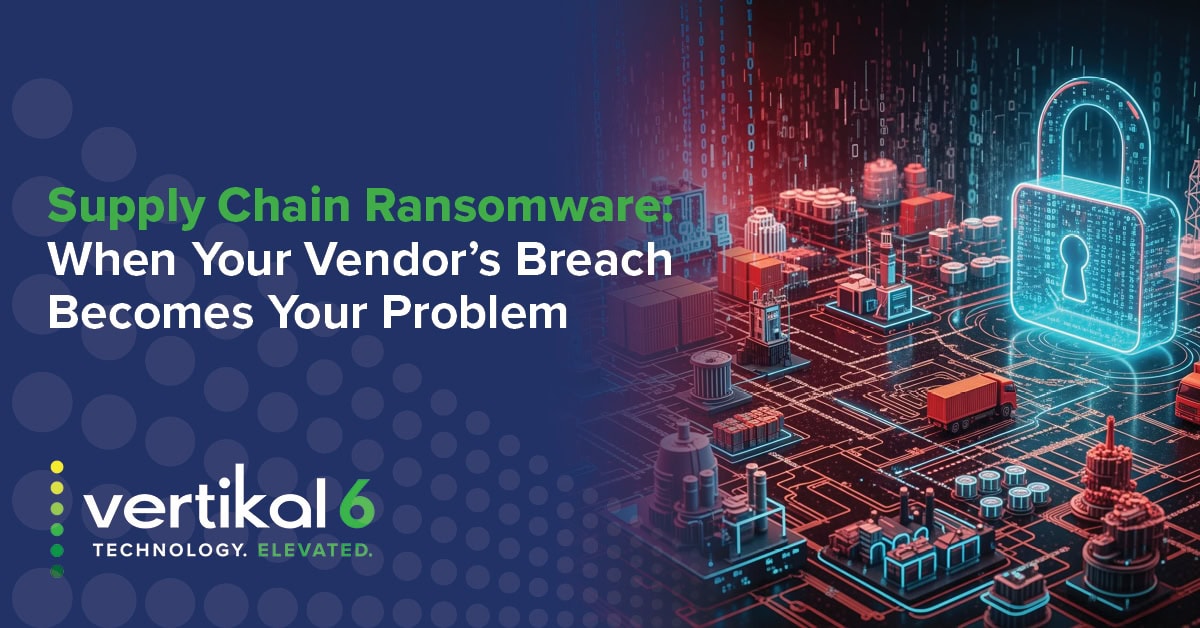
At 3 AM on a Tuesday, a manufacturing plant manager receives an alert: their industrial parts supplier’s ordering system is offline due to ransomware. By 9 AM, production lines are slowing because they can’t verify incoming shipment schedules. By noon, the plant is deciding whether to halt operations entirely. The manufacturer’s own cybersecurity was flawless—but their vendor’s breach became their operational crisis.
How Vendor Ransomware Reaches Your Operations
Operational dependencies amplify impact far beyond the initial breach. Just-in-time manufacturing relies on real-time vendor data about shipments and inventory levels. When that data disappears behind ransomware encryption, manufacturing operations face immediate decisions about whether to continue production without visibility. Healthcare supply chains depend on distributor ordering systems for medications and surgical supplies. A ransomware attack that takes down a medical distributor’s systems can leave hospitals unable to order critical supplies within hours.
Vendor connections can also create shared vulnerabilities that extend the reach of an attack. Electronic Data Interchange (EDI) connections that enable automated ordering provide network-level access between organizations—a pathway that can be exploited if not properly secured. Vendor portals with single sign-on can expose credentials that work across multiple systems. Integrated supply chain management systems share vulnerabilities across organizational boundaries, meaning a weakness on your vendor’s side of the integration creates risk in yours.
Data exposure is another consequence of a cybersecurity incident that extends beyond the initial victim. Your organization’s data sits in vendor systems during attacks—customer records, transaction history, proprietary specifications. When vendors get hit with ransomware, that data may be encrypted, exfiltrated, or both. You still bear responsibility for notifying customers under breach notification laws, even though the breach occurred in someone else’s environment.
“The most dangerous words in supply chain security are ‘that’s our vendor’s problem,'” says Vin DiPippo, Chief Technology Officer at Vertikal6. “When your critical supplier goes down, you have minutes to hours—not days—before it affects your operations. You need to know about their breach before your production line does.”
The 24-Hour Vendor Breach Response
When you learn a critical vendor has been hit with ransomware, the first 24 hours determine whether their crisis remains theirs or cascades into yours.
Hour 0-2: Rapid Assessment Verify the vendor breach through official communication channels—not social media or news reports. Identify which of your systems connect to the affected vendor. Notify your IT security team immediately so they can begin monitoring for indicators of compromise. Review recent vendor data exchanges for potential signs of exposure, then isolate or monitor the connection and reset credentials used to access vendor portals or shared systems—don’t wait for confirmed evidence of compromise before acting.
Hour 2-8: Immediate Protective Actions Determine the operational impact if vendor systems remain offline for 72 hours or longer and activate business continuity plans for affected dependencies. Your IT security team should continue watching for lateral movement attempts from the vendor network into your environment.
Hour 8-24: Operational Adaptation Engage alternative vendors or activate manual processes for critical functions to maintain operations while your primary vendor recovers. Communicate with customers about potential service disruptions. Document all operational changes for regulatory and insurance purposes. Coordinate with the vendor on their recovery timeline and the scope of any data exposure.
“You can’t wait for your vendor to finish their forensics before protecting yourself,” DiPippo explains. “The moment you learn about their breach, you need to assume your data in their systems is compromised and act accordingly.”
Building Supply Chain Resilience
Conducting vendor risk assessments must move beyond checkbox compliance exercises. Request evidence of the vendor’s incident response testing, not just policies. Verify that vendors maintain offline backups and practice recovery procedures. Require notification SLAs for security incidents affecting shared data—define specific timeframes like 24 or 48 hours.
Design redundancy into critical vendor relationships. Identify which vendors, if they went offline for 72 hours, would halt your operations. Establish secondary vendors for mission-critical services before a crisis occurs. Test failover to backup vendors during business continuity exercises.
Implement contractual protections for cyber incidents. Include breach notification requirements in vendor contracts with specific timeframes. Define liability and responsibility for supply chain security incidents. Establish data handling requirements and encryption standards as contractual obligations. Require cyber insurance coverage minimums for high-risk vendors.
The Shared Responsibility Reality
Your vendor’s security is fundamentally your security. The smallest vendor in your chain can create the largest operational impact. You cannot outsource cybersecurity risk by delegating functions to third parties.
HIPAA business associate agreements hold both covered entities and business associates responsible for protecting patient information. SEC cyber disclosure rules may require reporting vendor incidents that materially impact your operations. Cyber insurance increasingly asks detailed questions about vendor risk management during underwriting—including whether each vendor connection represents a potential ransomware pathway if not properly secured, and whether you’ve approached those connections from a zero-trust perspective with verified security controls on both sides.
“Every vendor connection is a potential ransomware pathway,” DiPippo notes. “The question isn’t whether to trust your vendors—it’s whether you’ve verified their security and prepared for the day their breach affects your operations.”
Conclusion
Supply chain ransomware transforms third-party relationships from business partnerships into shared cybersecurity responsibilities. When a vendor gets hit, the impact on your operations can be immediate and severe—regardless of your own security posture. The organizations that weather supply chain attacks successfully aren’t those with perfect vendors; they’re the ones who’ve identified their critical dependencies, established backup options, and practiced responding to vendor incidents before the crisis arrives. In today’s interconnected business environment, your cybersecurity perimeter extends to every vendor you rely on.